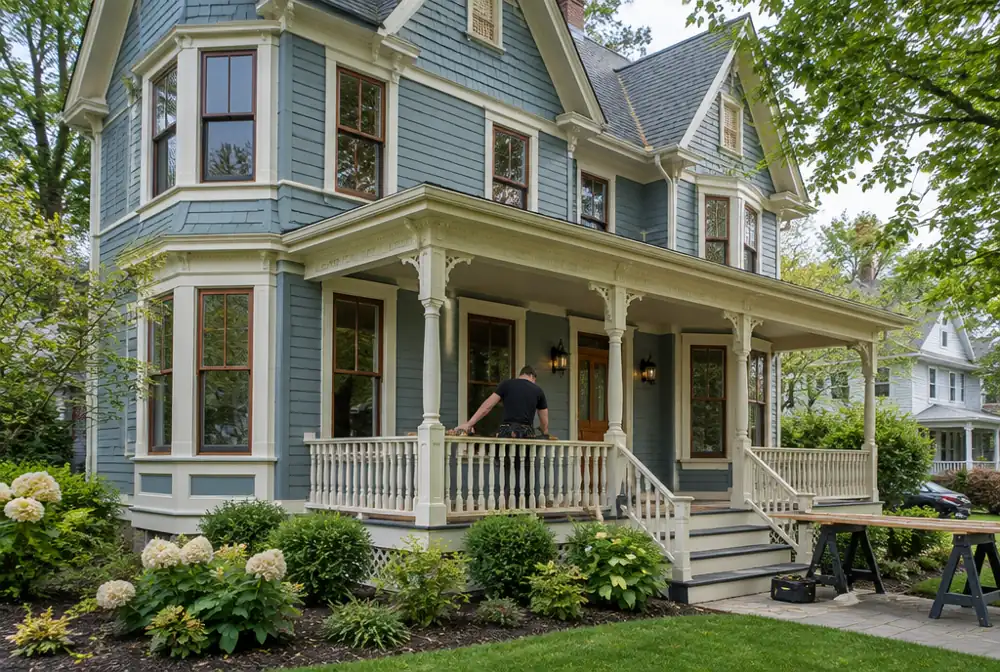
Quick answerA full renovation of a pre-1940 New Jersey home runs about $25,000 for a single room brought properly up to date, and $150,000 to $250,000 and up for a whole-house renovation with new systems. Typical price: $25K – $250K+. Licensed & insured, written itemized price before work starts, no deposit, one dedicated crew. Serving all 21 New Jersey counties from Paramus. Call (201) 676-3099 or book a free estimate.
What we do
- Whole-house renovations of pre-1940 homes
- Kitchens and baths in old houses, without gutting the character out
- Plaster repair, skim coating and ornamental plaster patching
- Knob-and-tube and cloth wiring replacement (our licensed electricians)
- Fuse box and 60-amp service upgrades to modern panels
- Cast iron waste stack and galvanized supply replacement (in-house master plumber)
- Original window restoration, storm windows and matching replacements
- Millwork matched to existing profiles — casing, base, crown, stair parts
- Radiator and steam system work, plus mini-splits where there are no ducts
- Insulation and air sealing that doesn't trap moisture in old walls
- Structural repair — sagging floors, cut joists, failing sill plates
- Historic commission and certificate of appropriateness applications
- Asbestos and lead testing, with licensed abatement coordinated
- Slate, tile and cedar roof repair, and matching replacements
- Masonry repointing with lime mortar, not modern portland mix
- Permits, inspections and township zoning review
What's actually behind the walls of a pre-1940 NJ house
- Knob-and-tube wiring: no ground, cloth insulation that crumbles, and it was never designed for a house with a microwave and three computers. It also can't be legally buried in insulation. If you're insulating, it has to go first.
- Cast iron waste stacks: 80 to 100 years old, rusting from the inside. They fail at the hub joints and inside walls. A stack that's scaled shut is why the second-floor tub drains slowly and nothing you snake fixes it.
- Galvanized supply lines: they close up with corrosion, which is why the shower drops to a trickle when someone flushes.
- Plaster over wood lath: three coats, a half inch thick, and it does not hold a drywall anchor. Also much better at sound than drywall, which is why old houses are quiet.
- Balloon framing: stud bays that run uninterrupted from the basement to the attic. Great for running wire, terrible in a fire, and it needs fire blocking added when we open a wall.
- Rough-sawn true dimensional lumber, joists at odd centers, and floors that have settled. Normal. We work to the house, not to a tape measure.
- Asbestos in pipe wrap, floor tile, mastic and siding, and lead in nearly every painted surface. Both are fine undisturbed and both need handling once you start cutting.
Do you need historic commission approval in New Jersey?
It depends on whether your house is in a locally designated historic district, which is a municipal designation — not the same thing as being old, and not the same thing as being on the state or national register. Towns like Cape May, Montclair, Morristown, Princeton, Bordentown, Haddonfield, Lambertville and parts of Ridgewood and Rutherford have local districts with a historic preservation commission.
Where a district applies, exterior changes visible from the street usually need a certificate of appropriateness before the construction permit is issued. That covers windows, siding, roofing material, porches, doors, railings and additions. Interior work almost never needs it — you can gut a kitchen in a historic district without a commission hearing.
We find out which applies before you spend money on drawings. We prepare the application, the photos and the product specs, and we go to the meeting. Commissions say yes far more often than people expect when the submission shows matching profiles and materials instead of a vinyl catalog page.
Keep it or replace it — how we decide
Original wood windows: usually keep. A sash with wavy glass and old-growth wood can be re-corded, re-glazed and weather-stripped for less than a replacement, and with a good storm window it performs close to a modern double-pane. If the sash is rotted through or the frame is gone, we replace — and in a district, we match the sightlines, the muntin pattern and the material.
Plaster: keep and repair. Skim coating over sound plaster costs less than gutting to drywall and it keeps the wall thickness, the casing reveals and the sound deadening. We only take plaster down where it's separated from the lath or where the wall has to open for wiring or plumbing anyway.
Knob-and-tube and cast iron: replace. Every time. These aren't character, they're the two things most likely to cost you a claim or a fire. We open walls surgically — in closets, behind base, from above and below — and we patch plaster rather than drywalling the whole room.
Original trim, doors and hardware: keep. We strip, repair and rehang. Where new trim is needed, we gauge the existing profile and build it up to match rather than buying the closest thing at a lumberyard.
Lead and asbestos — what it adds and why we don't skip it
Anything painted before 1978 can have lead, and in pre-war North Jersey it almost always does. We use lead-safe work practices as standard: containment, wet methods, HEPA vacuums, no dry sanding on suspect surfaces, daily cleanup.
Asbestos shows up in pipe and boiler wrap, 9x9 floor tile and the black mastic under it, some popcorn ceilings, and cement siding. We test before demolition when the material is suspect. If it's positive, licensed abatement happens before we open the area, and it's a written line on your price with its own schedule — usually a few days and a few thousand dollars, sometimes more on a big boiler room.
Neither of these is a reason not to renovate. They're a reason to find out in week one instead of week six, which is the difference between a scheduled step and a stopped job.
Historic home contractors near you
Paramus-based, renovating pre-war homes across all 21 New Jersey counties. Master plumber, electricians and finish carpenters are all on our own crew — which matters more in a 1920s house than anywhere else, because the surprises come from all three trades at once.
Text photos of the house to (201) 676-3099 or email your inspection report to info@firstcallcontractingnj.com — we read those properly, and they tell us most of what we need before we walk in.
PRICE CHECK · NEW JERSEY 2026$25K – $250K+typical fixed-price range — your exact number goes in writing after a free visit
How we beat the big chains: Restoration-branded firms price old houses with a fear premium and a designer retainer, then subcontract the actual trades. No franchise fees, no commissioned salesmen, no rented subcontractors — that's typically 15–30% under national-brand quotes for the same or better spec. Bring us any written quote and we'll match the scope line by line.
What people hate about other companies — fixed here
The complaint“They gutted the plaster in a 1912 house and drywalled it. The casings stick out past the walls now and every room echoes.”
Our fixWe repair and skim plaster wherever it's sound, and we only open what has to open for wiring or pipe. Wall thickness, reveals and the way the trim sits are part of what you paid for when you bought the house.
The complaint“Halfway through the kitchen they found knob-and-tube and asbestos pipe wrap, and the job stopped for six weeks while the price got renegotiated.”
Our fixWe inspect like builders before we quote — open a bay, pull a register, look in the basement and the attic, and test suspect material. Knob-and-tube, cast iron and abatement go in the written price up front, so the number you sign is the number you pay.
The complaint“The contractor installed vinyl windows on a house in a historic district and the town made us take them out.”
Our fixWe check whether your address is in a locally designated district before anything is ordered, and we prepare and present the certificate of appropriateness application ourselves. You don't find out from a stop-work order.
Historic Homes questions, answered
How much does it cost to renovate an old house in NJ in 2026?
Budget roughly 15 to 25 percent more than the same scope in a newer house. A properly updated single room starts around $25,000, a kitchen or bath in a pre-war home runs $35,000 to $80,000, and a whole-house renovation with new wiring, plumbing and plaster work typically runs $150,000 to $250,000 and up.
Do I have to replace knob-and-tube wiring?
If you're renovating, insulating, or adding meaningful load, yes. Knob-and-tube has no ground, its cloth insulation fails with age, and it cannot be covered with insulation. Many insurers also won't write a policy on a house that still has it live. Our electricians replace it and pull the permit.
Can I keep my original windows?
Usually, and usually you should. Old-growth sash can be re-corded, re-glazed and weather-stripped, and with a good storm window it performs close to a modern insulated unit for less money. If a sash or frame is rotted beyond repair we replace and match the sightlines and muntin pattern — especially in a historic district.
Do I need approval from a historic commission?
Only if your property is in a locally designated historic district, and then generally only for exterior work visible from the street — windows, siding, roofing, porches, doors, additions. Interior renovations almost never need it. We confirm your address, prepare the certificate of appropriateness application and attend the meeting.
What about asbestos and lead paint?
We test suspect material before demolition — pipe wrap, old floor tile and mastic, some ceilings, cement siding. Positive results go to licensed abatement before we open the area, priced as its own written line. Lead-safe practices are standard on every pre-1978 house we work in.
How long does a historic renovation take?
A single room, two to four weeks. A pre-war kitchen or bath, six to ten. A whole-house renovation with systems replacement, four to eight months. Old houses take longer because nothing is a stock size and because opening a wall usually finds another decision — we build that reality into the schedule instead of apologizing for it later.
Is there historic homes near me?
If you're anywhere in New Jersey, yes. First Call Contracting is based in Paramus and handles historic homes across all 21 counties with our own licensed crew. Most of Bergen, Passaic, Hudson and Essex is 15 to 30 minutes from our shop, and emergencies are dispatched to the nearest crew 24/7. Call (201) 676-3099 or book a free in-home estimate.
Bring the systems to 2026. Leave the house where it belongs.
Plaster repaired · knob-and-tube and cast iron out · profiles matched · commission applications handled
Or call Alex direct: (201) 676-3099