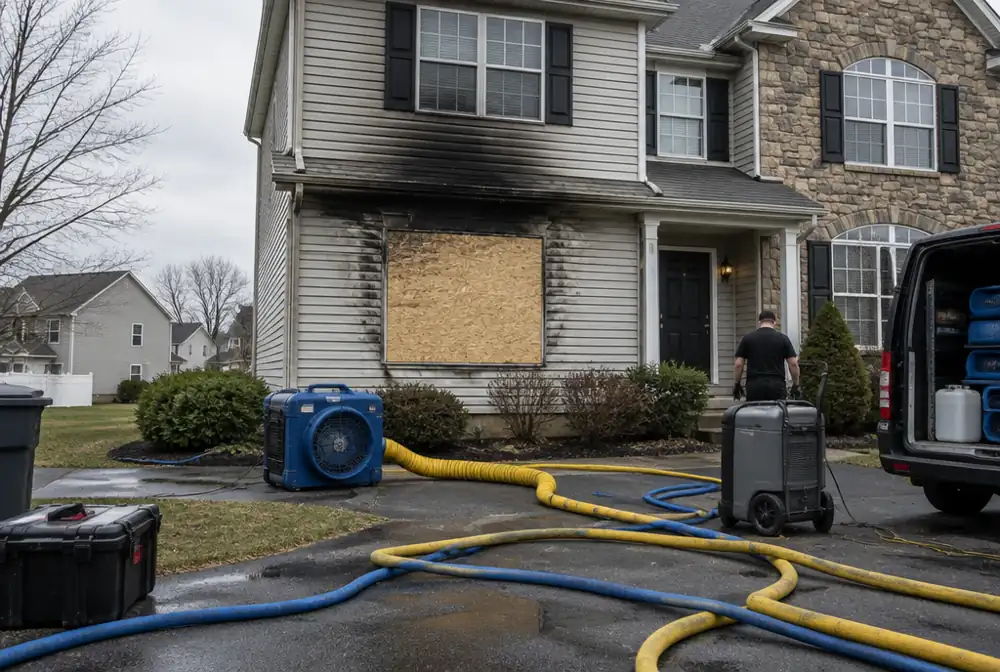
Quick answerFire damage restoration in New Jersey runs about $8,000 to $18,000 for a contained kitchen or single-room fire in 2026, and $30,000 to $80,000 or more when the framing burned and the house has to come apart. Typical price: $695 – $45K. Licensed & insured, written itemized price before work starts, no deposit, one dedicated crew. Serving all 21 New Jersey counties from Paramus. Call (201) 676-3099 or book a free estimate.
What we do
- Emergency board-up, temporary doors and roof tarping, 24/7
- Securing the house against weather and anyone walking in
- Soot and smoke film removal from walls, ceilings, trim and cabinets
- Protein-smoke and puff-back cleanup from kitchen and oil-burner fires
- Odor removal at the source — insulation, ductwork, carpet pad, sealed framing
- Water extraction and structural drying after the fire department
- Charred framing and sheathing removal, cleaning and sealing
- Post-fire electrical inspection and rewiring by our licensed electricians
- Heating, plumbing and duct replacement where heat reached them
- Contents pack-out, inventory and storage during the rebuild
- Full rebuild — framing, insulation, drywall, trim, floors, kitchen, paint
- Itemized, adjuster-ready scope and photo documentation
Do this right now
1. Don't go back in until the fire department hands the house back.Hot spots hide inside walls and in insulation for hours. Floors and stairs that look fine can be burned through underneath. Let the department shut the gas and kill the power, and don't flip anything back on yourself — melted wiring inside a wall will start the fire over again. If they've released the house, take photos from the doorway before you take a step in.
2. Take what you need and leave everything else exactly as it is.Grab medication, documents, phones and chargers, pets and a few days of clothes. Then stop. Don't wipe soot off walls, appliances or countertops — soot is greasy and acidic, and wiping it drives it into paint, grout and plastic so it can never come out. Don't run the heat or the AC; the ducts will carry the smell into rooms the fire never reached. Don't plug in anything that was in the fire.
3. Call (201) 676-3099.A real person picks up, day or night. Tell us where the fire was and whether the roof or windows are open. We board up, tarp and secure the house the same night — that part happens before anyone talks about price — and we walk it with you in daylight.
What we do when we arrive
First the house gets closed. Plywood over broken windows and kicked doors, a temporary door with a working lock, tarp and sheathing over any roof opening. An open house after a fire takes rain, animals and people, and your insurer expects you to prevent that — it's the one thing that has to happen tonight.
Then we find where the smoke actually went. Smoke follows air, so it travels up stud bays, over dropped ceilings, through return ducts and into closets two floors from the fire. We check with a light at an angle, pull a switch plate or two, and look in the attic and the ducts. That map decides the scope — and it's why a job that looks like one room often isn't.
Then the water. A fire department can put a thousand gallons into a house in a few minutes, and it's under the flooring, in the insulation and down inside the walls. We extract, set dehumidifiers and air movers, and meter the framing every day until it reads dry — same as any water loss, except now it's soaked in soot, so wet drywall and insulation come out instead of getting dried in place. Then cleaning, then odor, then rebuild: the same crew from the first sheet of plywood to the last coat of paint, on one written price you approve before we start.
Why the smoke costs more than the fire
Most of what you're paying for is smoke. Soot is acidic, and left alone it etches chrome, appliance finishes, glass and grout within a few days — that's the real reason speed matters, not a slogan. And there's more than one kind of it.
Dry smoke comes off a fast, hot fire: powdery, gray, and the easiest to take off. Wet smoke comes off a low, smoldering fire full of plastic: sticky, smeary, and it carries the worst smell. Protein smoke comes off a stove — a pot left on the burner — and it's almost invisible, a thin amber varnish on every surface in the house that smells like burnt meat for months. And in North Jersey we get puff-backs: an oil burner that misfires and blows a fine black oily film through the ductwork into every room. There was no fire at all, and the whole house still needs cleaning.
Cleaning is dry first — HEPA vacuum and chem sponge, because water sets soot — then washed, then rinsed. Anything porous that holds odor comes out: insulation, carpet pad, ceiling tile, and sometimes the top layer of charred framing gets planed or soda-blasted. Framing that stays gets sealed with a shellac-based primer, which is what actually locks the smell in, and ductwork gets cleaned or replaced. Only then do we run hydroxyl or ozone equipment. If somebody wants to skip the source work and just fog the house, walk away — the smell comes back the first humid week in June.
The parts people forget after a fire
- Wiring that got hot inside a wall but never showed a flame — our licensed electricians inspect the circuits that ran through the fire area before anything gets closed up
- The panel, the meter and the service mast if the fire reached the outside wall
- Heat exchangers, flex duct and the air handler, which spread smoke everywhere and often can't be cleaned
- Plumbing supply lines with heat-damaged plastic fittings and melted shutoff valves
- Attic insulation, which holds smoke odor longer than anything else in the house
- Windows with blown seals from heat, and vinyl siding on the neighboring wall that warped from radiant heat
- Smoke and carbon monoxide detectors — every one in the house gets replaced, not reset
Insurance after a fire — what we do and what we won't do
We photograph everything before we touch it, keep the moisture and cleaning logs, and write the scope line by line the way an adjuster reads it — room, surface, quantity, price. If your adjuster wants a walkthrough, we meet them at the house. Most policies also pay additional living expenses while you're out, and a contents claim separate from the structure; we'll show you where the line is so you don't leave money on the table.
What we won't do: we don't show up at a fire scene uninvited, we don't ask you to sign a direction-to-pay that hands us your claim before you've spoken to your own adjuster, and we don't inflate a scope because insurance is paying. Your price is in writing and it doesn't change without your signature on a change order — same as any other job we do.
Fire and smoke crews near you
Based in Paramus, serving all 21 New Jersey counties — 219+ towns. Board-ups and tarps often within the hour in Bergen, Passaic, Hudson, Essex and Morris; same-day dispatch with an honest arrival window everywhere else. The carpenter who boards it up, the electrician who checks the wiring and the crew who rebuilds the kitchen all work for us.
PRICE CHECK · NEW JERSEY 2026$695 – $45Ktypical fixed-price range — your exact number goes in writing after a free visit
Emergency board-up and roof tarping starts at $695 and runs to about $2,500 for a house with several openings and a roof hole. Soot cleaning, deodorizing and sealing one room is usually $1.5K – $5K. A contained kitchen or bedroom fire — cleaning, odor work, drying, demo and rebuild — typically lands between $8K and $18K. When the framing burned, the roof opened, or the smoke went through the whole house, expect $30K – $80K and up, itemized room by room. Contents pack-out and storage is priced on its own lines so you can see it.
How we beat the big chains: National restoration franchises bill your insurer by the day, by the fan and by the technician, then hand the rebuild to a subcontractor you've never met. No franchise fees, no commissioned salesmen, no rented subcontractors — that's typically 15–30% under national-brand quotes for the same or better spec. Bring us any written quote and we'll match the scope line by line.
What people hate about other companies — fixed here
The complaint“A truck was at the curb before the fire department left, and a guy in a polo shirt had my wife signing papers on the hood of his car.”
Our fixWe don't chase fire calls. We board the house up and secure it first, and nothing gets signed until you've walked it in daylight with a written, itemized price in your hand and your own adjuster on the phone.
The complaint“They cleaned, painted and left. The house still smelled like a fire every humid day that summer.”
Our fixPaint doesn't hold smoke odor back. We take out what holds the smell — insulation, pad, duct liner — seal the framing with a shellac-based primer, and then deodorize. If it smells in July, we come back.
The complaint“The mitigation company dried it out and disappeared. It took me four months to find someone to put the house back together.”
Our fixMitigation and rebuild are one job here, on one written price. The crew that cuts the burned drywall out is the crew that hangs the new kitchen cabinets.
Fire & Smoke Damage questions, answered
How much does fire damage restoration cost in NJ in 2026?
A contained kitchen or single-room fire usually runs $8,000 to $18,000 all in — cleaning, odor, drying, demo and rebuild. Emergency board-up and tarping on its own starts around $695. A fire that reached the framing or opened the roof runs $30,000 to $80,000 and up. You get the number itemized room by room before anything starts.
Can smoke smell really be removed, or do I have to replace everything?
It can be removed, but only by taking out what holds it. Insulation, carpet pad, ceiling tile and duct liner soak up odor and never give it back. Once those are gone and the framing is cleaned and sealed, hydroxyl or ozone equipment finishes it. Anyone who tells you a fogger alone will fix it is selling you a summer surprise.
How long does the whole thing take?
Board-up is the same night. Cleaning and drying is usually one to two weeks. The rebuild depends on what burned — a single room is two to four weeks, a kitchen and the rooms around it is six to ten, and a heavy structural loss can run four to six months once permits and insurance approvals are in. You get a written timeline with the price and a photo update text every workday.
Does homeowners insurance cover fire and smoke damage?
Fire is the thing homeowners policies were invented for, so yes, almost always — including the water the fire department used and the smoke damage in rooms that never burned. Coverage for contents, for additional living expenses while you're out, and for code upgrades the town now requires all have separate limits. We document all of it and tell you honestly where your policy stops.
Can I clean the soot myself to save money?
Please don't touch the walls. Soot is greasy, and a damp rag drives it into the paint and the grout where it becomes permanent — cleanable surfaces turn into replacement line items. Hard, non-porous things like tile floors and stainless you can wipe. Everything else, leave it and let us dry-clean it first.
Do I have to move out?
For a small, contained fire, often not — we seal the work area with plastic and run negative air. For anything with heavy smoke through the house, no gas or no electric, you'll be out for at least the cleaning phase. Most policies pay for that; we'll tell you straight on day one which one you're in so you can make arrangements.
Is there fire & smoke damage near me?
If you're anywhere in New Jersey, yes. First Call Contracting is based in Paramus and handles fire & smoke damage across all 21 counties with our own licensed crew. Most of Bergen, Passaic, Hudson and Essex is 15 to 30 minutes from our shop, and emergencies are dispatched to the nearest crew 24/7. Call (201) 676-3099 or book a free in-home estimate.
Closed up tonight. Back to normal by one crew.
Board-up and tarp first · soot and odor at the source · dried and metered · rebuilt on one written price
Or call Alex direct: (201) 676-3099