Quick answerA whole-basement dehumidifier installed with a condensate pump and a hard-piped drain runs about $1,800 to $3,800 in New Jersey; a ducted unit that dries a crawl space and a basement together runs $2,800 to $5,500. Typical price: $1.8K – $5.5K. Licensed & insured, written itemized price before work starts, no deposit, one dedicated crew. Serving all 21 New Jersey counties from Paramus. Call (201) 676-3099 or book a free estimate.
What we do
- Whole-basement dehumidifiers, 70 to 130 pints per day
- Crawl space dehumidifiers sized to the square footage
- Ducted units serving a basement and a crawl space together
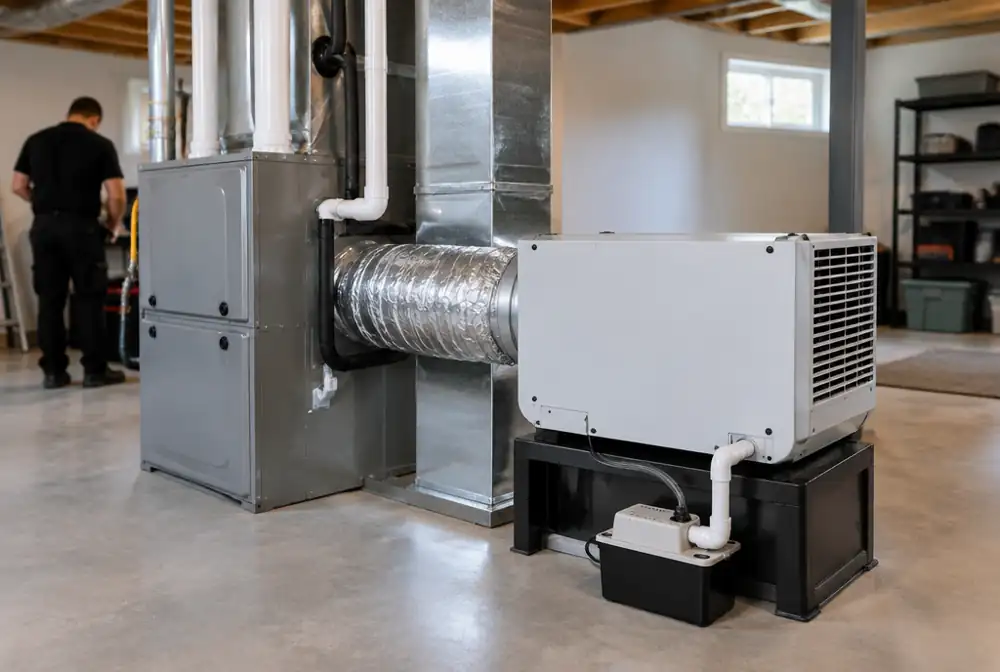
- Condensate pumps and hard-piped drain lines
- Gravity drains to a sump, a floor drain or outside
- Dedicated circuits and outlets by our licensed electricians
- Units hung from the joists to keep the floor clear
- Humidistats, remote monitoring and high-humidity alerts
- Crawl space encapsulation installed with the dehumidifier
- Rim joist air sealing and closing off crawl space vents
- Filter changes, coil cleaning and annual service
- Finding and fixing the water source before we sell you a machine
Why a store dehumidifier fails in a New Jersey basement
- Rating games. A consumer unit's pint rating is measured at 80°F and 60% humidity. Your basement is 62°F. That '50-pint' unit pulls a fraction of that down there.
- The bucket. Two gallons, and it fills overnight in July. Miss a day and the unit shuts off — which is exactly when you needed it.
- Short cycling. Undersized units run constantly, ice the coil, defrost, and run again. That's why they die in two or three seasons.
- No drain. A hose draped toward a floor drain kinks, backs up, or ends above the water line. We hard-pipe to a sump or a drain, or we install a condensate pump.
- Where it sits. On the floor, in a corner, breathing the same stale air. A whole-basement unit hangs from the joists and pulls from across the room.
- Lifespan. Consumer units are warrantied a year or two. Whole-basement units carry five-year warranties and are built with real compressors and coils — which is why the math works out even though the sticker is higher.
Humidity targets — what happens at each number
| Relative humidity | What's happening | What to do |
|---|
| Under 40% | Drier than it needs to be. Wood trim and furniture can shrink and check. | Dial the humidistat back. You're paying for electricity you don't need. |
| 45–55% | The target. Mold can't get going, dust mites struggle, the air smells like nothing. | Leave it. Change the filter twice a year. |
| 55–60% | Borderline. Cardboard boxes start to feel soft, you notice it when you go down the stairs. | Set the humidistat to 50% and see whether the unit can hold it. |
| 60–70% | Mold is growing on joists, boxes, leather and the back of drywall. This is the classic musty-basement smell. | You need a properly sized unit and a look at where the water is coming from. |
| Over 70% | Condensation on cold surfaces, active mold, rusting tools, possible standing water somewhere. | Find the water source first. A dehumidifier alone won't win this one. |
Find the water before you buy a machine
A dehumidifier pulls moisture out of air. It does not stop water coming in. If your humidity is high because a downspout dumps at the foundation, because the grade runs toward the house, because the sump pit has no lid, or because a crawl space has bare dirt in it, the machine will run forever and lose.
So we look first: gutters and downspouts, grade, window wells, the cove joint, the sump lid, the dryer vent, and whether the bath fans upstairs are actually ducted outside. Half the 'we need a dehumidifier' calls we get turn out to be a $300 downspout extension and a sealed sump lid, and we'll tell you that even though it's the smaller ticket.
Crawl spaces: seal it, then dry it
Putting a dehumidifier in a vented crawl space with a dirt floor is like air conditioning your driveway. Open vents pull in humid summer air that condenses on cool surfaces, and bare earth puts gallons of moisture into the air every day.
The sequence is: seal the floor and walls with a reinforced vapor liner, close the vents, insulate and air-seal the rim joist, then hang a dehumidifier sized to the space with its condensate hard-piped or pumped out. Done that way, a crawl space holds 50 percent all summer and the floors above it stop feeling cold and damp. Done backwards, you buy a machine that never shuts off.
How the job goes
Measure and readWe measure the space, take a humidity reading, look for the water source, and check where the nearest drain and circuit are. You get an itemized written price with a model number on it.
Size itSized by square footage, ceiling height and how wet the space actually is — not by whatever's on the shelf. A unit that's too small runs forever; too big short-cycles and dies early.
ElectricalOur licensed electricians run a dedicated circuit and outlet where it's needed. No extension cords, no sharing the circuit with the freezer.
Hang and ductUnit hung from the joists on isolation hangers so it's quiet and your floor stays clear. Ducted to return and supply where one unit serves two spaces.
Drain itHard-piped by gravity to a sump, floor drain or outside — or a condensate pump with the line run properly and secured. This is the part people cheap out on and then flood.
Set and verifyHumidistat set, and we come back or check remotely to confirm the space is actually holding 45 to 55 percent. You get the reading, not a promise.
What it costs to run
A whole-basement unit draws roughly 5 to 8 amps when the compressor is running, and in a properly sealed space it only runs part of the time. Most New Jersey homeowners see something in the range of a few dollars a week in the humid months and nearly nothing from November to March.
The cheapest thing you can do for the running cost has nothing to do with the machine: seal the sump lid, extend the downspouts, close the crawl vents and insulate the rim joist. Every gallon that doesn't get into the air is a gallon the compressor doesn't have to pull back out.
Dehumidifier installers near you
Paramus-based, installing basement and crawl space dehumidifiers across all 21 New Jersey counties, with the electrical and the drain done in-house. If you've got a unit somebody else hung and it's icing up or dumping on the floor, we service those too. Send a hygrometer reading and a photo of the space to info@firstcallcontractingnj.com and we'll tell you what size you need.
PRICE CHECK · NEW JERSEY 2026$1.8K – $5.5Ktypical fixed-price range — your exact number goes in writing after a free visit
How we beat the big chains: The waterproofing chains bundle a dehumidifier into a $20,000 system at a number nobody can itemize. Ours is a line item with a model number, a pints-per-day rating and the electrical spelled out — buy it on its own if that's all you need. No franchise fees, no commissioned salesmen, no rented subcontractors — that's typically 15–30% under national-brand quotes for the same or better spec. Bring us any written quote and we'll match the scope line by line.
What people hate about other companies — fixed here
The complaint“They sold me a dehumidifier and never mentioned the downspout washing straight into the window well.”
Our fixWe look for the water source before we quote a machine. If a $300 downspout extension and a sealed sump lid fix it, that's what we tell you — even though it's the smaller job.
The complaint“The drain hose was just draped toward the floor drain. It kinked and put ten gallons on my finished floor.”
Our fixEvery unit we install is hard-piped by gravity or pumped with a secured, sloped line and a check valve. No hoses lying on the floor, no 'that should be fine.'
The complaint“The crawl space unit runs 24 hours a day and the space is still damp and smells.”
Our fixThat's a vented crawl with a dirt floor. Liner down, vents closed, rim joist sealed — then the dehumidifier. In that order it holds 50 percent and shuts off. Backwards, it never wins.
Basement Dehumidifiers questions, answered
How much does a basement dehumidifier cost installed in NJ?
About $1,800 to $3,800 for a whole-basement unit with a condensate pump or hard-piped drain, and $2,800 to $5,500 for a ducted unit serving a basement and crawl space together. A dedicated circuit, if you need one, is priced on its own line. Crawl space encapsulation is a separate scope we'll quote alongside it.
What humidity should a New Jersey basement be?
45 to 55 percent relative humidity, year round. Above 60 percent mold grows on joists, boxes and the back of drywall — that's the musty smell. Below 40 percent you're just paying for electricity and drying out wood trim. Buy a $15 hygrometer and leave it on a shelf down there; it's the most useful tool in the basement.
Why won't a hardware store dehumidifier do the job?
Because its pint rating is measured at 80°F and your basement is in the low 60s, so it pulls far less than the box claims. Add a two-gallon bucket that fills overnight in July, a coil that ices in cool air, and a one-year warranty, and most of them are dead in two or three seasons. A whole-basement unit is rated for basement conditions, drains itself and carries a five-year warranty.
Will a dehumidifier fix a wet basement?
No. It fixes humid air. If water is actually entering — through the cove joint, a crack, a window well or the floor — you need drainage, a sump, crack repair or exterior work, and the dehumidifier is what you add after. We'll tell you which problem you actually have before quoting a machine.
Does a crawl space need a dehumidifier or encapsulation?
Usually both, in that order: encapsulation first, dehumidifier second. A sealed liner and closed vents stop the moisture coming out of the dirt and in through the vents; the dehumidifier handles what's left. A dehumidifier alone in an open, dirt-floored crawl runs constantly and still loses.
How much does it cost to run?
Roughly 5 to 8 amps while the compressor runs, and in a sealed space it only runs part of the time — a few dollars a week in the humid months and close to nothing in winter. Sealing the sump lid, extending downspouts and insulating the rim joist cuts the run time more than any setting on the unit.
Is there basement dehumidifiers near me?
If you're anywhere in New Jersey, yes. First Call Contracting is based in Paramus and handles basement dehumidifiers across all 21 counties with our own licensed crew. Most of Bergen, Passaic, Hudson and Essex is 15 to 30 minutes from our shop, and emergencies are dispatched to the nearest crew 24/7. Call (201) 676-3099 or book a free in-home estimate.
No smell. No boxes going soft.
Sized for a basement · hung off the joists · drained for real
Or call Alex direct: (201) 676-3099