Quick answerMold is a water problem with a fungus on top. Typical price: $1.2K – $12K. Licensed & insured, written itemized price before work starts, no deposit, one dedicated crew. Serving all 21 New Jersey counties from Paramus. Call (201) 676-3099 or book a free estimate.
Water damage & mold work we do
- Leak source found and fixed — roof, plumbing, window, foundation
- Emergency water extraction & dry-out
- Moisture-meter mapping of walls, floors & ceilings
- Containment & negative air for larger areas
- Wet drywall, insulation, carpet & trim removal
- HEPA cleaning & antimicrobial treatment of framing
- Attic mold from bath fans & poor ventilation
- Basement & crawl-space moisture control
- Coordination with independent mold testing when it's needed
- Rebuild — insulation, drywall, paint, trim, flooring
- Ceiling repair under roof & plumbing leaks
- Insurance photos & itemized documentation
Do this right now
1. Stop the water.Shut the main water valve if it's a pipe or an appliance. Put a bucket under a roof or ceiling leak and poke a small drain hole in any bulge. If it's a slow leak you just found — under a sink, behind a toilet, around a window — shut the valve that feeds it. Mold can't grow without the water. Stop the water first, every time.
2. Move people out of the room and don't spread it.Anyone with asthma or allergies stays out. Close the door. Don't run the central heat or AC through that room — the ducts carry spores to the rest of the house. Open a window if it's dry outside. Do not spray bleach on drywall: it doesn't reach the roots in porous material and it adds more water. And don't tear moldy drywall out yourself if the patch is bigger than a card table — you'll put more in the air than you take off the wall.
3. Call (201) 676-3099.Text a photo of the stain or the growth and where the water came from if you know. A real person answers, tells you whether it's tonight or tomorrow morning, and whether it's the kind of job that needs an independent test first.
What we do when we arrive
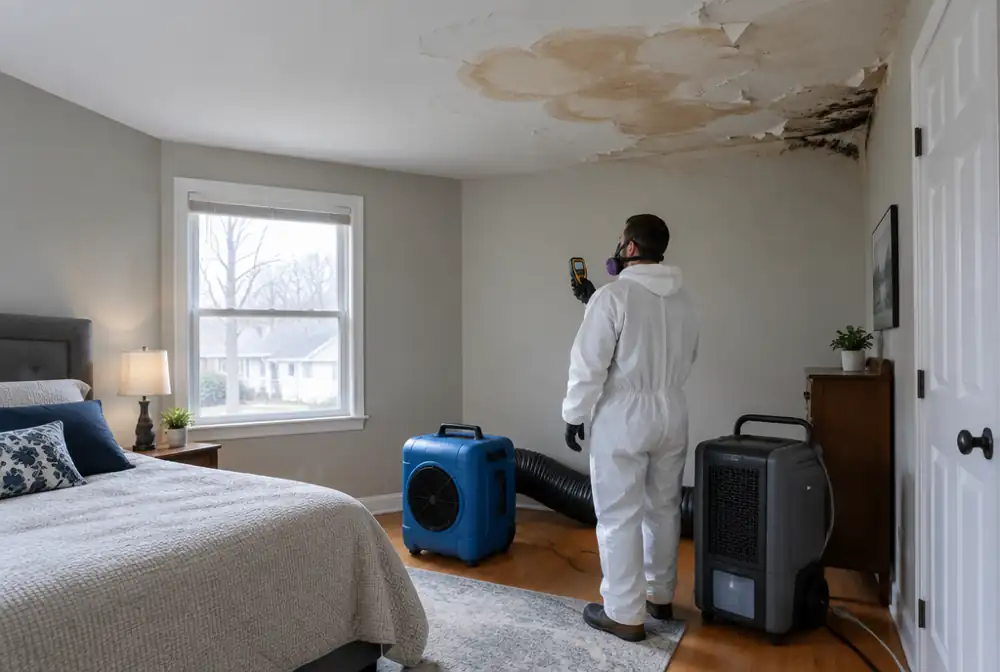
First the source. A stain on the ceiling has a roof or a pipe above it; black at the base of a basement wall has groundwater or a slab leak behind it; mold in the attic almost always has a bath fan dumping shower steam into the insulation. Our roofer, plumber and carpenter are one crew, so whichever it is, the same visit fixes it. Then we map the wet area with a moisture meter — walls, floor, ceiling — and mark it, because water travels far past what you can see.
Then the removal. Drywall that's been wet more than a day or two gets cut a foot or two above the wet line and bagged. Wet insulation, carpet pad, base trim and anything with growth on it comes out. For bigger areas we hang plastic containment and run a negative-air machine so nothing drifts into the rest of the house. The framing gets HEPA-vacuumed and treated with an antimicrobial. Then dehumidifiers and air movers run for three to five days while we check the meter every day.
When the numbers say dry, the equipment leaves — that day, not next week — and the same crew rebuilds: insulation, drywall, tape, paint, trim, flooring. One written price for the whole thing, and you hold the final payment until you've walked it with us.
When you actually need a mold test — and when you don't
Honest answer: most of the time you don't. If you can see mold and you know where the water came from, testing tells you what you already know, and the fix is the same — stop the water, remove what's ruined, dry it, rebuild. We'd rather put that $500 into the repair.
You do want an independent test when: you smell it but can't find it, and the walls need to be opened to look; someone in the house is sick, has asthma or a weak immune system and the doctor wants documentation; the area is large — bigger than about ten square feet — or it's inside the ductwork; you're buying, selling or renting the house and someone needs a clearance letter; or your insurance company asks for one. In those cases we'll point you to an independent, certified mold assessor. We don't test our own work, and you shouldn't hire anyone who does — the person who tests should never be the person who profits from the result.
One more thing worth knowing: New Jersey doesn't currently license mold remediators, so anyone can print the word "certified" on a truck. Ask who fixes the water. If the answer is "someone else," keep looking.
Where mold hides in New Jersey homes
- Attics — a bath fan venting into the insulation, or a roof that can't breathe; black sheathing over the bathroom is the giveaway
- Behind the drywall in finished basements that flooded once and were "dried" with a box fan
- Under sinks and behind toilets from a slow supply-line drip
- Around windows where the flashing failed, inside the wall below the sill
- The ceiling under a bathroom — a failed shower pan or a tub overflow gasket
- Crawl spaces with dirt floors and no vapor barrier
- The wall behind the washer and the floor under the dishwasher
Insurance: sudden water yes, slow leaks usually no
A burst pipe, a failed water heater, a storm-damaged roof — sudden and accidental — is usually covered, and most policies cover the mold that results up to a limit, often $5K to $10K. A leak that dripped for six months, a wet basement from groundwater, or a bath fan that's been venting into the attic since 2009 usually isn't. We photograph everything, mark the moisture readings on the wall, and give you an itemized invoice. And we'll tell you before you file which kind you have, so you don't put a denied claim on your record.
Water damage crews near you
Based in Paramus, serving all 21 New Jersey counties — 219+ towns. Often within the hour in Bergen, Passaic, Hudson, Essex and Morris for active water; same-day dispatch with an honest arrival window everywhere else. The plumber, the roofer and the carpenter who rebuilds are the same crew.
PRICE CHECK · NEW JERSEY 2026$1.2K – $12Ktypical fixed-price range — your exact number goes in writing after a free visit
Drying a single room after a leak — extraction, dehumidifiers and air movers for three to five days, verified with a meter — runs $1.2K – $4K. Removing the wet drywall, insulation, pad and trim adds $800 – $3K depending on the area. Rebuilding a room — insulation, drywall, tape, paint, trim — runs $1.5K – $8K. A finished basement or several rooms after a major leak can run $10K – $25K, itemized. Independent mold testing, when it's needed, is paid to the tester — usually $300 – $700 — not to us.
How we beat the big chains: Restoration franchises bill your insurance by the day and by the fan, then hand the rebuild to a subcontractor you've never met. No franchise fees, no commissioned salesmen, no rented subcontractors — that's typically 15–30% under national-brand quotes for the same or better spec. Bring us any written quote and we'll match the scope line by line.
What people hate about other companies — fixed here
The complaint“The mold company sprayed something, painted over it and charged $3,000. Four months later it was back, because the pipe was still dripping.”
Our fixWe don't treat mold without fixing the water. The plumber or roofer is on the same truck, and the source is the first line on your invoice — with a photo of it fixed.
The complaint“They sold me a $900 mold test to tell me there was mold on the wall I could see.”
Our fixIf you can see it and we know the source, we'll tell you the test is a waste of your money. When a test is genuinely needed, we point you to an independent assessor — we don't sell tests and we don't test our own work.
The complaint“The restoration crew dried it and left. Then I spent six weeks finding somebody to put the walls back.”
Our fixThe crew that opens the wall is the crew that closes it — insulation, drywall, paint, trim — on the same written price. You don't chase a second contractor.
Mold & Water Damage questions, answered
How fast does mold start after a leak?
Growth can start within 24 to 48 hours on wet drywall, wood and carpet pad. That's why the first call matters more than the cleanup product. Stop the water today, get the wet material out and the drying started within a day or two, and you usually avoid a mold job altogether.
Can I just clean it with bleach?
On a hard, non-porous surface like tile or a tub — sure. On drywall, wood or insulation, no. Bleach is mostly water; it wets the material more and doesn't reach the roots. Small spots on a painted wall can be scrubbed with detergent; anything bigger than a couple of square feet, or anything you can smell but not see, needs the material removed.
Do I have to leave the house during the work?
Usually not. We contain the work area with plastic and run negative air on bigger jobs so the rest of the house stays clean. People with asthma or a compromised immune system should stay out of the affected room until the rebuild is done — we'll tell you honestly if the job is big enough that you'd be more comfortable elsewhere.
How long does the whole job take?
Stopping the water and removing the wet material: the first visit. Drying: three to five days, verified with a meter. Rebuild: a few days for a single room, longer for a finished basement. You get the timeline in writing with the price and a photo update text every workday.
Will my insurance pay for mold removal?
If the water was sudden and accidental — a burst pipe, a storm — usually yes, with a mold limit on most policies. If the leak was slow or long-term, usually no. We document everything either way and tell you which case you're in before you file.
Is the mold in my attic dangerous?
Attic mold from a bath fan or poor ventilation rarely affects the air you breathe downstairs, but it eats the roof sheathing and it kills your home sale. The fix is the ventilation and the fan duct, then treating the sheathing. It's usually a one- or two-day job and it's one of the most common things we find in Bergen and Essex County attics.
What actually counts as water damage?
Anything where water got somewhere it shouldn't and stayed: a supply line letting go, an ice dam pushing water under the shingles, a washer hose, a slow toilet flange leak that rotted the subfloor, a sewer backup, or storm water coming through a wall. What matters for the repair is which kind — clean supply water, gray water from a fixture or appliance, or contaminated black water from a sewer or flood. Each one gets treated differently, and we tell you which one you have before we start.
How do you keep mold from growing after the water is out?
Speed and measurement. Extracting the standing water is the easy part; what stops mold is getting the framing, subfloor and cavities back to normal moisture within a few days, using air movers and dehumidifiers and checking with meters instead of guessing by feel. We open or remove what won't dry in place, document the readings daily, and don't close a wall until the numbers say it's dry. Guessing is how a repaired room smells musty six months later.
Is there mold & water damage near me?
If you're anywhere in New Jersey, yes. First Call Contracting is based in Paramus and handles mold & water damage across all 21 counties with our own licensed crew. Most of Bergen, Passaic, Hudson and Essex is 15 to 30 minutes from our shop, and emergencies are dispatched to the nearest crew 24/7. Call (201) 676-3099 or book a free in-home estimate.
Water first. Then mold. Then the room, back to normal.
Source fixed · dried and verified with a meter · rebuilt by the same crew
Or call Alex direct: (201) 676-3099