Quick answerWet basements in New Jersey usually come from three places: roof water dumped at the foundation, a high water table after a nor'easter, and cracks in the wall or slab. Typical price: $500 – $25K+. Licensed & insured, written itemized price before work starts, no deposit, one dedicated crew. Serving all 21 New Jersey counties from Paramus. Call (201) 676-3099 or book a free estimate.
What we do
- Downspout extensions, underground drains & regrading
- Window well drains, covers & replacement
- Interior perimeter drain (French drain) systems
- Sump pits, pumps & battery backups
- Epoxy & polyurethane crack injection
- Foundation parging, sealing & exterior membrane on exposed walls
- Carbon-fiber straps & wall anchors to a stamped engineer's plan
- Slab crack & cove-joint sealing
- Drain board & vapor barrier on block walls
- Basement dehumidification
- Backwater valves for sewer backups
- Engineer coordination for settlement, bowing & horizontal cracks
Where the water is coming from — the three usual suspects
- Roof water. A 2,000-square-foot roof sheds over 1,200 gallons in a one-inch rain. If the downspouts end at the wall, that water is going into your basement.
- Ground water. Clay soil and a high water table push water up through the slab and in at the joint where the floor meets the wall — the cove joint. This shows up hours after the rain stops.
- Cracks. Block walls leak through mortar joints; poured walls crack where they shrank or settled. A vertical crack that seeps is normal and fixable. A horizontal crack or a wall that bows is structural.
- Plus the pretenders: a sweating cold-water pipe, a leaking water heater, a window well with no drain. We rule those out first because they're the cheapest fix of all.
Outside first: the fixes that cost hundreds, not thousands
Before anyone cuts your floor, we fix what's cheap to fix. Downspouts get extensions or an underground pipe that carries water 6 to 10 feet away or to daylight. Dirt that slopes toward the house gets regraded to fall away from it. Window wells get a drain and a cover. Gutters get cleaned, re-pitched or replaced if they're overflowing. A lot of 'my basement floods every spring' calls end right here, for a few hundred to a couple thousand dollars. If a company skips this step and goes straight to a $15,000 interior system, they're selling you the system, not solving the problem.
Inside: perimeter drains and sump systems
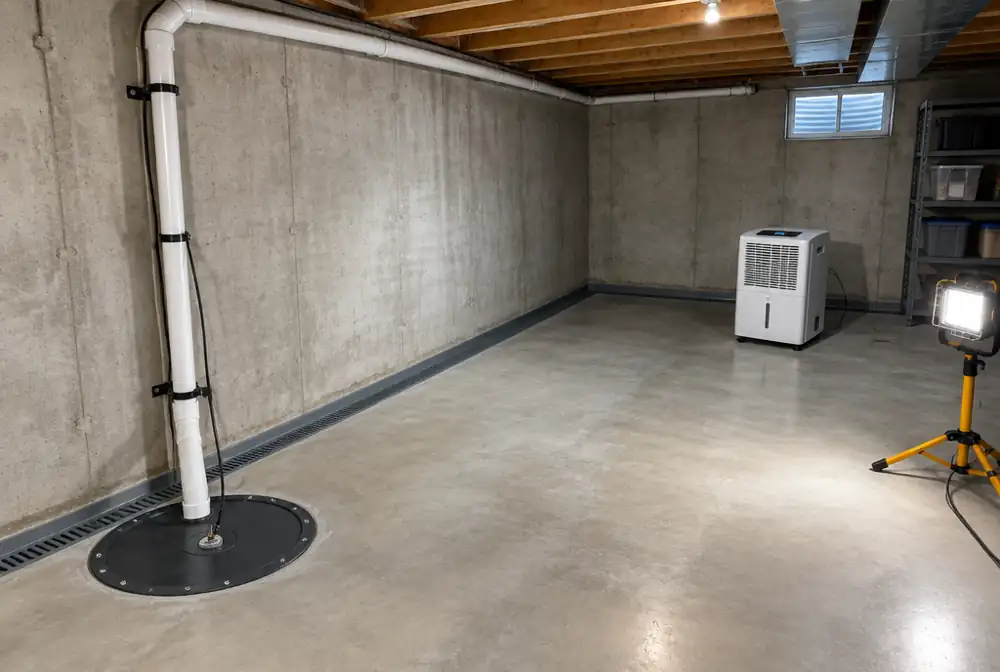
When the water is coming up from below, the answer is to give it an easier path. We cut the slab along the wall, dig a trench, set perforated pipe in stone, and pitch it to a sump pit. New concrete goes back over it, flush. A drain board goes on block walls to catch what weeps through the joints and drop it into the trench. The pit gets a sealed lid, a primary pump sized to the flow, a check valve, a discharge line that ends well away from the house — and a battery backup, because the storm that floods your basement is the one that kills the power. We're the same crew that installs and services sump pumps, so the pump isn't an afterthought.
Cracks: which ones we inject, which ones need an engineer
Vertical and diagonal cracks in a poured wall that seep water get injected — polyurethane foam if the crack is wet and moves with the seasons, epoxy if it's dry and we want it structurally bonded. The injection goes all the way through the wall, not a surface patch that peels off in a year. Block walls can't be injected; they get a drain board and a sealed cove joint. Slab cracks get routed and sealed. Every crack we fix, we photograph and mark on your paperwork with a date.
When a structural engineer is needed — and why we bring one
A crack that runs horizontal, a stair-step crack in block that's open more than a quarter inch, a wall that's bowed inward, a floor that slopes, or a crack that's grown since you first noticed it — those are structural, and we don't guess. We bring in a licensed New Jersey professional engineer, you get a stamped report that says what's moving and why, and we build the repair to that plan: carbon-fiber straps for a wall that's bowed a little, steel beams or anchors for one that's moved more, underpinning if it's settling.
The engineer works for you, not for us, so nobody's selling you eight wall anchors you don't need. The report also matters when you sell — buyers' inspectors ask for it.
How the job goes
InspectWe walk the outside first — gutters, downspouts, grade, wells — then the inside with a moisture meter and a level. We look at every crack and note where the water marks are.
PriceItemized in the order we'd do it: exterior fixes, then interior drain by the foot, pit and pump, crack injection per crack, dehumidifier, and any engineered work as its own line after the report.
BuildExterior work takes a day. An interior perimeter system in a typical basement takes two to four days, with dust walls up and the slab cut wet to keep the dust down. Injection is a few hours per crack.
TestWe flood-test the drain, run the pump on power and on battery, and walk you through the sump so you know what normal sounds like. Then you sign off.
Basement waterproofing contractors near you
Paramus-based, drying basements across all 21 New Jersey counties. Water in the basement right now? Our emergency line answers 24/7 and we pump out the same day.
PRICE CHECK · NEW JERSEY 2026$500 – $25K+typical fixed-price range — your exact number goes in writing after a free visit
How we beat the big chains: Waterproofing chains pay a commissioned 'inspector' to sell one system to every basement, and the system is priced to cover his cut. No franchise fees, no commissioned salesmen, no rented subcontractors — that's typically 15–30% under national-brand quotes for the same or better spec. Bring us any written quote and we'll match the scope line by line.
What people hate about other companies — fixed here
The complaint“The waterproofing company's 'inspector' spent ten minutes downstairs and quoted $18,000 for a full interior system. My downspout was the problem.”
Our fixWe start outside, and we tell you when a $600 downspout fix is the answer. An interior system goes in your quote only if the water is coming up from the ground — and we show you the evidence.
The complaint“They injected the crack from the surface. It looked fine for a year, then the patch peeled and it leaks again.”
Our fixInjection ports go into the crack and the material is pushed through the full thickness of the wall until it shows on the other side. We photograph every port, and the crack is covered by our 5-Year Watertight Guarantee.
The complaint“The wall is bowed and the salesman had a contract for eight anchors in his truck before he'd even measured it.”
Our fixBowed walls get a licensed engineer's report before any repair is priced. You get a stamped plan that says what's needed, and we build exactly that — no more.
Waterproofing & Foundation questions, answered
How much does basement waterproofing cost in NJ in 2026?
Outside fixes — extensions, grading, window well drains — run about $500 to $3,000. Crack injection runs $500 to $1,500 per crack. A full interior perimeter drain with a sump pit, pump and battery backup runs about $6,000 to $18,000 for a typical basement, priced by the linear foot. Engineered wall repairs start around $600 to $1,000 per carbon-fiber strap, with the engineer's report first. Fixed and itemized before we start.
Interior or exterior waterproofing?
Exterior membrane and footing drains are the gold standard for new construction, but on an existing house it means excavating around the foundation — landscaping, walks, decks, utilities — and it costs several times more. For most existing New Jersey basements, an interior drain and sump does the job at a fraction of the cost. We do exterior membrane on walls that are already exposed.
Is a wet basement a deal-breaker when I sell?
A wet basement is. A dry basement with paperwork isn't. Buyers' inspectors want to see a working sump with a backup, sealed cracks with dates, and an engineer's letter if there was ever structural work. We give you all three.
Will the interior drain take care of a bowed wall?
No. A drain handles water; a bowed wall is a structural problem caused by soil pressure or a bad footing. The two often go together, and we fix both — but the wall gets an engineer's plan first.
Do I need a permit?
Cutting the slab, adding a sump discharge and any structural wall repair need a permit in New Jersey. Downspout extensions and grading don't. We pull whatever's required and meet the inspector.
Can you finish the basement afterward?
Yes, and that's the right order — dry first, pretty second. We're the same company that frames, plumbs and finishes basements, so the drain, the pump, the egress window and the bathroom can go on one contract.
Can I fix a foundation crack myself?
A hairline crack in a poured wall that's dry and not moving can be sealed with an injection kit, and plenty of homeowners do it. What you can't do from the inside is fix why it cracked — grading, a downspout dumping at the corner, or a footing that's moving. Anything wider than about an eighth of an inch, anything stair-stepped through block, and anything that keeps weeping needs to be looked at by somebody who inspects like a builder.
How serious is a crack in my foundation?
It depends on shape and movement, not drama. Thin vertical cracks in a poured wall are common shrinkage and are usually about water, not structure. Horizontal cracks, stair-step cracking in block, a wall bowing inward, or doors upstairs that suddenly won't latch are structural and need attention. We photograph and measure what you have and tell you plainly which one it is — we don't sell you a pier you don't need.
Does foundation work have to be done right away?
Movement doesn't reverse itself, and every New Jersey freeze-thaw cycle and every wet spring pushes it a little further — so waiting usually makes the repair bigger, not cheaper. That said, most foundation issues are not a this-week emergency. We tell you what's urgent, what can wait until spring, and what's just cosmetic, then hold the written price for 90 days so you can think about it.
Will homeowners insurance pay for foundation repair?
Usually not. Standard New Jersey policies exclude settling, earth movement and long-term seepage, which covers most foundation work. What may be covered is sudden accidental damage — a burst supply line washing out soil, or a vehicle impact. If you think you have a claim, we document the cause with photos and measurements and work with your adjuster; if you don't, we'll tell you that too instead of running you through a claim that gets denied.
How do you decide which foundation repair I need?
By what's moving and which way. Vertical settlement gets push piers or helical piers driven to stable soil; a wall being pushed in by soil pressure gets carbon fiber straps if it's minor or wall anchors and bracing if it isn't; water with no movement gets an interior drain, a sump and exterior correction. We measure, photograph and explain before we price, and the itemized number is fixed before work starts.
Is there waterproofing & foundation near me?
If you're anywhere in New Jersey, yes. First Call Contracting is based in Paramus and handles waterproofing & foundation across all 21 counties with our own licensed crew. Most of Bergen, Passaic, Hudson and Essex is 15 to 30 minutes from our shop, and emergencies are dispatched to the nearest crew 24/7. Call (201) 676-3099 or book a free in-home estimate.
Dry basement. Straight wall. Paperwork to prove it.
Outside first · drains and pumps sized to the water · engineer before anchors · 5-Year Watertight on everything that carries water
Or call Alex direct: (201) 676-3099