Quick answerHalf of what you breathe on the first floor came up through the crawl space. Typical price: $4.5K – $18K+. Licensed & insured, written itemized price before work starts, no deposit, one dedicated crew. Serving all 21 New Jersey counties from Paramus. Call (201) 676-3099 or book a free estimate.
What we do
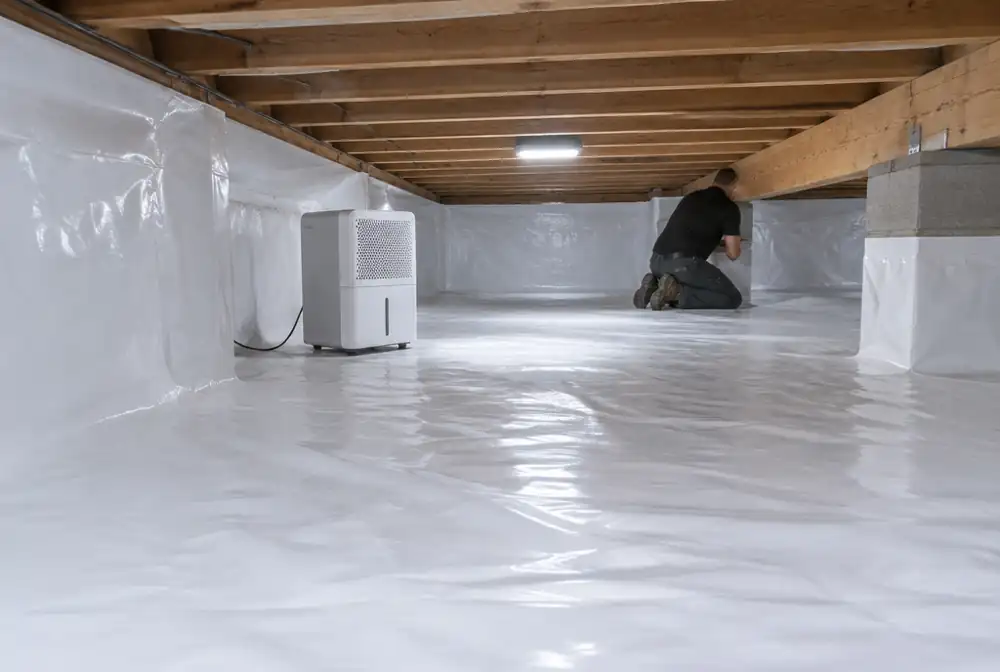
- 12- to 20-mil reinforced vapor liner, sealed at seams, walls & piers
- Vent closing & sealed access door
- Rigid foam insulation on foundation walls
- Rim joist air sealing & insulation
- Crawl space dehumidifier with condensate pump
- Interior drainage & sump pump for wet crawls
- Standing water removal & grading of the crawl floor
- Mold treatment of joists & subfloor before sealing
- Rotted sill plate, joist & subfloor repair
- Duct sealing and insulation in the crawl
- Downspout, grading & window well fixes outside
- Termite inspection strip left clear
Why vented crawl spaces fail in New Jersey
The old code idea was that vents let a crawl space dry out. In a New Jersey July, outside air is 75 degrees and sticky, and the crawl space is 60 degrees. That air comes in through the vents, hits the cold joists and the AC ducts, and condenses — the crawl gets wetter every time it 'breathes.' Insulation stuffed between the joists soaks it up and falls down. Mold grows on the joists, the sill plate softens, and in winter the same vents let cold air under your floors. The fix that works is the opposite of venting: seal it and dry it.
What encapsulation is — and what it isn't
Encapsulation means turning the crawl space into a sealed, dry box that's part of the house. A reinforced polyethylene liner — 12 mil minimum, 20 mil where you'll crawl on it — goes over the dirt, overlapped and taped at the seams, run up the walls and sealed to them and to every pier. Vents get foam-blocked and sealed. The rim joist gets air-sealed. The walls get rigid foam. A dehumidifier sized for the space runs on a humidistat and drains to a pump or a floor drain.
What it isn't: a liner thrown on the dirt with the vents left open, which is the 'encapsulation' some companies sell for a low price. Half a seal is no seal.
Wet crawl? Drainage first.
If water stands in the crawl after a storm, a liner alone would just float. We fix the outside first — downspouts, grading, window wells — and if water still comes in, we trench a perimeter drain to a sump pit with a sealed lid and a pump, the same way we do a basement. The liner goes over the drain. And if the joists or subfloor are already black with mold or soft, we treat the wood and replace what's rotten before anything gets sealed over it — sealing in a problem is worse than leaving it open.
Insulate the walls, not the floor
Once the crawl is sealed, it's inside the house, so it gets insulated at the foundation walls with rigid foam, not with fiberglass between the joists. Wall insulation stays put, keeps the ducts and pipes in conditioned space, and makes the floors above warmer in January. One rule we follow in New Jersey: we leave a 3-inch inspection strip at the top of the wall bare so a termite inspector can see the sill — pest companies need that, and so will your buyer's inspector.
How the job goes
InspectWe go in with a light and a moisture meter: standing water, wood moisture, mold, insulation condition, ducts, the sill and rim, pests, and where the vents and access are. Photos of everything, because you probably haven't been down there.
PriceItemized: outside drainage fixes, interior drain and sump if needed, mold treatment and wood repair, liner by the square foot with wall height, vents and door, wall foam, rim joist, dehumidifier, duct sealing.
WorkDebris and old insulation out, wood treated and repaired, drain and sump if needed, liner, walls, vents, dehumidifier. Two to five days for a typical crawl.
VerifyWe take wood-moisture readings and a humidity reading, show you the dehumidifier set-up, and hand you the photos. Then you sign off.
Crawl space contractors near you
Paramus-based, encapsulating crawl spaces across all 21 New Jersey counties — ranches, capes, shore houses on piers, and additions built over a crawl.
PRICE CHECK · NEW JERSEY 2026$4.5K – $18K+typical fixed-price range — your exact number goes in writing after a free visit
How we beat the big chains: Crawl space chains sell a branded liner at a price built around a commissioned inspector and a truck full of upsells. No franchise fees, no commissioned salesmen, no rented subcontractors — that's typically 15–30% under national-brand quotes for the same or better spec. Bring us any written quote and we'll match the scope line by line.
What people hate about other companies — fixed here
The complaint“The crawl space company laid plastic on the dirt, called it encapsulated, and charged $9,000. The vents were still open.”
Our fixOur liner is sealed at every seam, run up the walls and sealed to them and to the piers, the vents are foam-blocked and sealed, and the rim joist is air-sealed. If air can get in, it's not encapsulated, and we don't call it that.
The complaint“They sealed it up over black joists. Now the smell is worse and it's under plastic.”
Our fixMold gets treated and rotten wood gets replaced before a square foot of liner goes down. We show you the wood-moisture readings and the photos first.
The complaint“Two winters later the fiberglass they put between the joists is on the ground again, soaked.”
Our fixWe don't insulate crawl-space floors. The walls get rigid foam, the rim joist gets sealed, and the dehumidifier keeps the space dry — so nothing is left to soak up water and fall.
Crawl Space Encapsulation questions, answered
How much does crawl space encapsulation cost in NJ in 2026?
For a typical 800-to-1,500-square-foot crawl: liner, sealed vents, wall foam, rim joist and a dehumidifier run about $4,500 to $12,000. Add a perimeter drain and sump for a wet crawl and you're at $12,000 to $18,000 and up. Mold treatment and wood repair are priced by what we find and shown to you first. Fixed and itemized.
Will it stop the musty smell upstairs?
In most houses, yes. The smell is mold and damp air rising through the floor. Seal the crawl, hold it under 55 percent humidity, and the source is gone. If the smell has gotten into insulation or carpet upstairs, we'll tell you what else needs to come out.
Isn't closing the vents against code?
No. New Jersey allows an unvented, conditioned crawl space when the ground is covered with a sealed vapor retarder and the space is either dehumidified or supplied with conditioned air. That's exactly what we build, and we pull the permit where the town wants one.
What about radon?
A sealed liner tends to reduce radon coming up from the soil, but encapsulation is not a radon system and we don't claim it is. If you've never tested, test — a certified New Jersey radon professional can install a mitigation system, and a sealed crawl makes their job easier.
How long does it last?
The liner is rated for decades; the dehumidifier is the part that wears out, typically in 8 to 12 years. We show you how to check the humidity reading and the drain so you know it's working, and we service it if it stops.
Do you need to fix the outside first?
Usually a little: downspouts moved away, a low spot regraded, a window well drained. It's cheap and it takes load off the crawl. We include those fixes in the quote when they matter.
How do I know I have a crawl space problem?
The tells are usually upstairs: a musty smell in the hallway, floors that feel cold or bouncy over the crawl, cupping hardwood, high humidity in summer, more bugs and mice than usual, and heating bills that don't match the house. Down below you'd see standing water, wet or hanging fiberglass batts, rusty duct straps, or white growth on the joists. Send us a couple of photos by text and we'll tell you what we're looking at.
Is a damp crawl space an emergency?
Standing water, sewage, or joists and girders that are soft when you push a screwdriver into them — yes, call us today. Everything else is on a clock, not a fuse: damp earth keeps feeding moisture into the house, and mold and rot get more expensive every season, but it's a next-few-months problem, not a tonight problem. We'll tell you which one you have, and the quoted price holds for 90 days.
Can I just lay plastic down in the crawl space myself?
A ground sheet is better than bare dirt, but taped-together hardware store poly on the floor isn't encapsulation and won't fix the humidity. A real job means fixing the water coming in first, then a heavy liner sealed up the walls and to the piers, sealed vents and rim joists, insulation, and a dehumidifier or conditioned air so the space stays dry. Half a job usually just traps moisture somewhere new.
Is there crawl space encapsulation near me?
If you're anywhere in New Jersey, yes. First Call Contracting is based in Paramus and handles crawl space encapsulation across all 21 counties with our own licensed crew. Most of Bergen, Passaic, Hudson and Essex is 15 to 30 minutes from our shop, and emergencies are dispatched to the nearest crew 24/7. Call (201) 676-3099 or book a free in-home estimate.
Dry underneath. Warm upstairs. No more smell.
Sealed liner · closed vents · insulated walls · dehumidified · inspected with photos
Or call Alex direct: (201) 676-3099