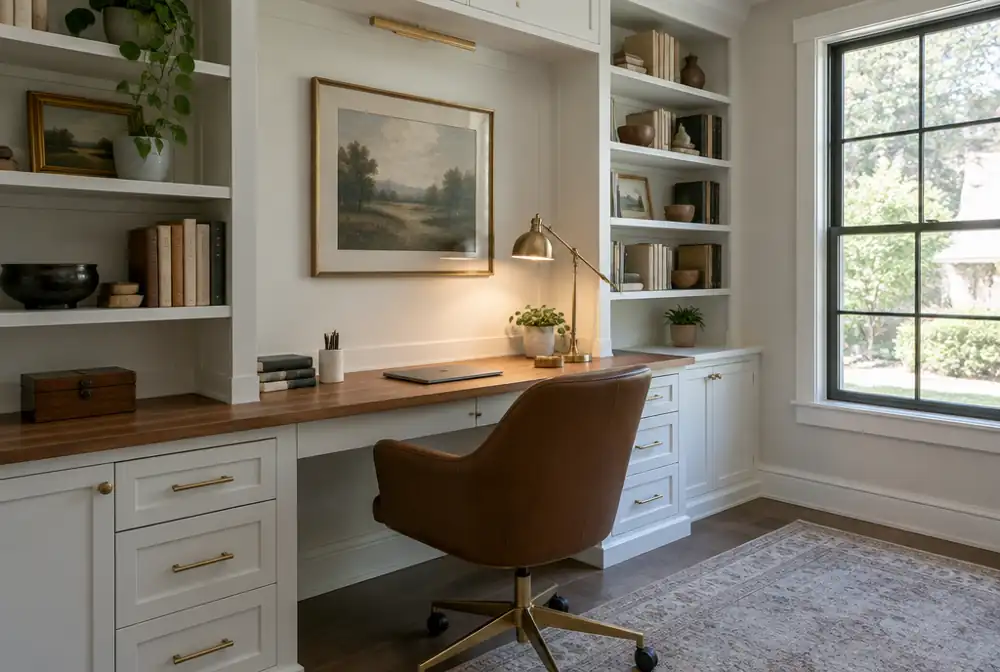
Quick answerConverting a spare bedroom into a real home office in New Jersey runs about $8,000 to $20,000 in 2026. Typical price: $8K – $45K. Licensed & insured, written itemized price before work starts, no deposit, one dedicated crew. Serving all 21 New Jersey counties from Paramus. Call (201) 676-3099 or book a free estimate.
What we do
- Spare bedroom conversions to a working office
- Basement offices with egress, moisture control and real ceiling height
- Attic offices with dormers, insulation and code stairs
- Garage conversions into heated, insulated office space
- Built-in desks, credenzas, file walls and bookcases
- Soundproofing — insulated walls, solid-core doors, resilient channel
- Dedicated 20-amp circuits for equipment (our licensed electricians)
- Hardwired ethernet drops and a clean network closet
- Layered lighting: recessed, task and a light on your face for video
- Ductless mini-splits for rooms the HVAC never reached
- Cable management, floor boxes and hidden chases
- Flooring, trim, paint and a video-call backdrop wall
- Half-bath additions near a converted space (in-house plumbing)
- Permits, zoning review and inspections
Where the office should go
Spare bedroom ($8K–$20K)The cheapest and usually the best. The room already has heat, a window and a floor. You're buying quiet, power, light and built-ins. Two to three weeks.
Basement ($18K–$40K)Quietest room in the house and the hardest to get right. Moisture has to be solved first, ceiling height checked against code, and an egress window is required if it's ever a bedroom. Four to six weeks.
Attic ($20K–$45K)Great light, real headaches: headroom, floor joists often sized for storage not living space, code stairs, and insulation done properly at the roofline. A shed dormer buys the headroom. Five to eight weeks.
Garage ($22K–$45K)The most space for the money if you can give up the bay. Slab insulated, walls furred and insulated, a real heat source, the overhead door replaced with a wall and window. Zoning matters here — some townships have parking requirements. Four to seven weeks.
How do you soundproof a home office?
Sound comes in two ways: through the air and through the structure. You need to stop both, and most of what people buy online only touches one.
For airborne sound — the TV downstairs, a dog, a kid on a trumpet — the fixes are mass and sealing. A solid-core door instead of the hollow one costs a few hundred dollars and is the single biggest improvement in any office. Then weatherstrip the door and put a sweep at the bottom, because a quarter-inch gap under a door leaks more noise than the whole wall.
For structure-borne sound, you break the path: mineral wool or dense batts in the stud bays, resilient channel or clips under the drywall, and a second layer of drywall where it really matters. On a basement office we insulate the joist bays overhead, which kills footsteps from the kitchen.
What we don't sell you is foam panels on the wall. Those change how the room sounds on your microphone — useful, and cheap — but they don't stop noise getting in. Different problem, different product.
Power, network and light
- A dedicated 20-amp circuit for the desk. Two monitors, a dock, a printer and a space heater on a shared 15-amp bedroom circuit is how you find out the panel is full.
- Outlets where the desk actually is — at desk height behind the built-in, plus a floor box if the desk floats in the room.
- Hardwired ethernet to the desk, run back to where the modem lives, terminated in a small wall-mounted panel instead of a nest of cable in a closet. Wi-Fi is fine until the day it isn't, and that day is always during a presentation.
- Recessed lighting on a dimmer for the room, task lighting on the desk, and something in front of you rather than behind you so you're not a silhouette on video.
- A panel check. Older Bergen and Essex homes on 100-amp service with a full panel need a sub-panel or an upgrade before we start adding circuits — our electricians do that work and it goes on the price as its own line.
Do you need a permit for a home office in New Jersey?
Painting a spare room and adding furniture, no. Almost everything else on this page, yes. New circuits, a mini-split, framing new walls, finishing a basement, converting a garage, or cutting in an egress window all fall under the NJ Uniform Construction Code and need permits and inspections.
Garage conversions add a zoning question on top of the building permit, because some townships require a certain number of off-street parking spaces per dwelling. We check that with your municipality before you spend money on drawings, not after.
We file the permits, schedule the rough and final inspections, and meet the inspector. You don't take a day off for any of it.
Home office builders near you
Paramus-based, building offices across all 21 New Jersey counties. Same foreman every day, a photo update text every workday, and the dust sealed off from the rest of the house while you keep working in it.
Text photos of the space to (201) 676-3099 or email your floor plan to info@firstcallcontractingnj.com and we'll come back with options and a number.
PRICE CHECK · NEW JERSEY 2026$8K – $45Ktypical fixed-price range — your exact number goes in writing after a free visit
How we beat the big chains: Design-build firms charge a design retainer before you know the number, then a builder's margin on top of the drawings you already paid for. No franchise fees, no commissioned salesmen, no rented subcontractors — that's typically 15–30% under national-brand quotes for the same or better spec. Bring us any written quote and we'll match the scope line by line.
What people hate about other companies — fixed here
The complaint“The contractor finished the basement beautifully and every footstep from the kitchen sounds like it's in the room with me.”
Our fixWe insulate the joist bays and isolate the ceiling before the drywall goes up. Sound control is a line on your quote with a named assembly, not an afterthought once the room is closed.
The complaint“They ran everything off the existing bedroom circuit and now the breaker trips when the space heater comes on.”
Our fixOur licensed electricians put the office on its own 20-amp circuit and check the panel's capacity before we promise anything. If the panel is full, you get that number up front instead of a trip at 2 p.m. on a Tuesday.
The complaint“The garage conversion was never permitted and it came up in the title work when we tried to sell.”
Our fixWe pull permits on every conversion, get the inspections signed off, and hand you the paperwork at the end. An unpermitted room is a discount on your house and we won't build one.
Home Offices questions, answered
How much does a home office cost in NJ in 2026?
Converting an existing spare bedroom runs about $8,000 to $20,000 with built-ins, soundproofing, a dedicated circuit and lighting. Building an office in a basement, attic or garage runs $18,000 to $45,000 because you're creating the room as well as finishing it.
How long does it take?
Two to three weeks for a spare bedroom. Four to six weeks for a basement, five to eight for an attic with a dormer, four to seven for a garage conversion. You get the schedule in writing before we start and a photo update every workday.
What actually makes a room quiet?
A solid-core door with weatherstripping and a sweep, dense insulation in the walls and the ceiling joists, and drywall isolated from the framing where it matters. In that order, by value for money. Foam panels on the wall improve how your microphone sounds but don't block noise coming in.
Can you heat and cool a converted garage or attic?
Yes, usually with a ductless mini-split. Extending the existing system into a space it was never sized for is how you get a room that's 58 degrees in January. A single-zone mini-split heats and cools independently and runs on its own circuit — we install both.
Do I need a permit?
For new circuits, framing, a mini-split, finishing a basement or converting a garage, yes — all of that is permitted work under the NJ Uniform Construction Code. We pull the permits and meet the inspectors. Garage conversions can also need a zoning check for parking requirements, which we do before you spend on drawings.
Will a home office add value to my house?
A finished, permitted room with heat and light adds square footage a buyer and an appraiser can count. An unpermitted garage conversion does the opposite — it shows up in the title work and becomes a negotiation against you. Build it properly and it counts.
Is there home offices near me?
If you're anywhere in New Jersey, yes. First Call Contracting is based in Paramus and handles home offices across all 21 counties with our own licensed crew. Most of Bergen, Passaic, Hudson and Essex is 15 to 30 minutes from our shop, and emergencies are dispatched to the nearest crew 24/7. Call (201) 676-3099 or book a free in-home estimate.
A door that closes and a room that works.
Quiet built in · dedicated circuit · hardwired drop · permitted and inspected
Or call Alex direct: (201) 676-3099