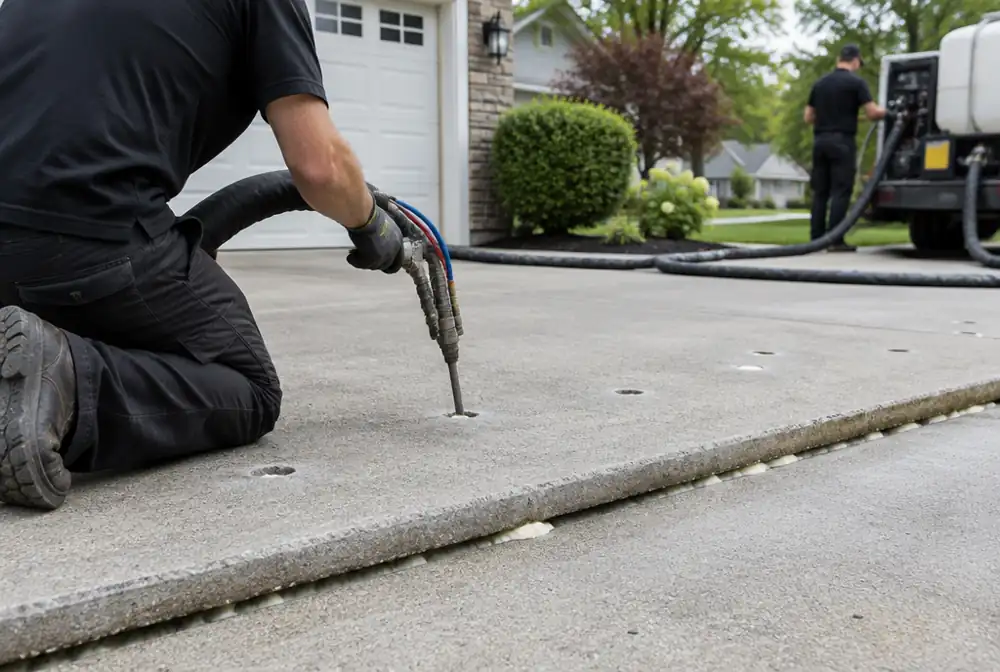
Quick answerLifting a sunken concrete slab with polyurethane foam costs about $2 to $6 per square foot in New Jersey, so most driveway aprons, front walks and patio jobs land between $695 and $2,500 and you can drive or walk on it the same afternoon. Typical price: $695 – $4.5K. Licensed & insured, written itemized price before work starts, no deposit, one dedicated crew. Serving all 21 New Jersey counties from Paramus. Call (201) 676-3099 or book a free estimate.
What we do
- Polyurethane foam concrete lifting (the modern mudjacking)
- Sunken driveway slabs and garage aprons
- Front walks, sidewalks and paths with trip edges
- Patio slabs and pool decks
- Garage floors and basement slabs
- Concrete steps, stoops and landings
- Trip hazards ground flush where lifting isn't needed
- Void filling under slabs, behind retaining walls and around pipes
- Joint and crack sealing after the lift
- Downspout, grading and drainage fixes so it doesn't sink again
- Honest replacement quotes when a slab is past saving
- Slab lifting before new pavers, a coating or a resurface
Why New Jersey slabs sink
- Freeze-thaw. Water in the soil under a slab freezes, swells, then thaws and leaves a void. We go through dozens of those cycles a winter here.
- Washed-out fill. A downspout dumping at the corner of a garage apron will hollow out the base under it in a few seasons. This is the number one cause we find.
- Poor compaction. Huge numbers of North Jersey homes went up fast in the 1950s through the 1970s, with backfill dumped around foundations and never properly compacted. Forty years later it's still settling.
- Clay. Piedmont clay soils swell wet and shrink dry, and they move slabs with them.
- Trees. A mature oak or maple pulls hundreds of gallons out of the soil in a dry August, and the slab drops with it. Roots lift the other side.
- Old trenches. Sewer, water and gas lines were cut through and backfilled loose. Slabs poured over those lines sink in a line you can see.
- High water table. In the coastal plain and the shore towns, groundwater moves fines out from under a slab every time it rises and falls.
How polyurethane foam lifting works
We map the voidsWe measure the drop with a level and a string line and figure out where the base is missing, not just where the slab is low.
Penetration holesWe drill 5/8-inch holes — about the diameter of a pencil — in a pattern across the slab. Compare that to the 2-inch holes old mudjacking needed.
InjectionA two-part polyurethane is injected through a port. It expands under the slab, fills the void first, then starts to lift.
The liftWe raise in small increments, watching the slab with a level, so it comes up level instead of cracking. The foam is hard enough to drive on in about 15 minutes.
Patch and sealHoles patched with color-matched grout, joints and cracks sealed so water stops going back under the slab.
Fix the causeDownspout extended, grading corrected, or a drain added. Lifting a slab without fixing where the water goes just buys you a few years.
Foam vs mudjacking vs replacement
| Option | Typical NJ cost | Back in use | When it makes sense |
|---|
| Polyurethane foam lifting | $2–$6 per sq ft (most jobs $695–$2,500) | Same day, about 15 minutes after the lift | Slab is sound but sitting low; voids underneath; you want your driveway back today |
| Mudjacking (sand/cement slurry) | $1.50–$4 per sq ft | 24–48 hours | Large open areas where 2-inch holes and added weight don't matter. We rarely recommend it — the slurry is heavy and it washes out |
| Grinding the trip edge | $495 minimum visit | Immediately | One raised sidewalk lip, township violation notice, nothing structurally wrong |
| Tear out and repour | $9–$20 per sq ft | 5–10 days including cure | Slab is cracked into more than a few pieces, spalled, crumbling, or was never thick enough |
When we tell you to replace instead of lift
- The slab is broken into more than three or four pieces — there's nothing rigid left to lift.
- The surface is spalling and flaking from years of rock salt. Lifting a crumbling slab gives you a level crumbling slab.
- It was poured too thin to begin with. A 2-inch 'driveway' won't take the pressure.
- It's cracked with a big vertical offset and rebar or wire mesh is exposed and rusted through.
- Something structural is moving — if the garage wall is going down with the slab, that's a foundation job, not a concrete job, and we'll say so.
The water is the real problem
Almost every sunken slab we lift in New Jersey has water behind it. A downspout emptying two feet from the apron. A grade that runs toward the house instead of away. A patio that sheds into the corner it sits in.
We fix that in the same visit whenever we can — extend the downspout, add an underground line to daylight or a dry well, re-grade the strip beside the slab. It's usually a few hundred dollars, and it's the difference between a lift that lasts and one you're calling about in three years. If you'd rather skip it, we'll say so on the quote so nobody's surprised later.
Concrete leveling near you
Paramus-based, lifting concrete across all 21 New Jersey counties — driveways, walks, patios, pool decks, garage floors and steps. Text a photo with something for scale next to the low spot and we'll give you a straight answer on whether it's a lift or a replace. Photos go to (201) 676-3099 or info@firstcallcontractingnj.com, whichever is easier for you.
PRICE CHECK · NEW JERSEY 2026$695 – $4.5Ktypical fixed-price range — your exact number goes in writing after a free visit
How we beat the big chains: The national lifting brands run a commissioned rep with a tablet, a lifetime-warranty pitch and a price built around the franchise fee. Same foam, same rig, same afternoon — ours just doesn't have to pay for the ad campaign. No franchise fees, no commissioned salesmen, no rented subcontractors — that's typically 15–30% under national-brand quotes for the same or better spec. Bring us any written quote and we'll match the scope line by line.
What people hate about other companies — fixed here
The complaint“They lifted my driveway and never touched the downspout washing the dirt out. Two winters later it was back down.”
Our fixWe find the water first. Downspout extensions, grading and drains go on the same written quote as the lift, and we show you the washout channel before we start.
The complaint“The guy drilled holes the size of golf balls and the patches look terrible.”
Our fixFoam goes in through 5/8-inch ports, patched with color-matched grout. On a stamped or exposed-aggregate slab we place the ports in the joints and control lines where they disappear.
The complaint“They lifted it too fast and cracked my patio in half.”
Our fixWe raise in small increments with a level on the slab, filling the void before we apply any lift. A slab that's going to crack tells you first — and our guy is watching for it, not staring at a pressure gauge.
Concrete Leveling questions, answered
How much does concrete leveling cost in New Jersey in 2026?
Figure $2 to $6 per square foot of slab, with most residential jobs — a garage apron, a front walk, a section of patio — landing between $695 and $2,500. Big driveways or pool decks with deep voids run higher. You get an itemized written price before anyone drills a hole.
How long does polyurethane concrete lifting take?
Most jobs are two to four hours start to finish. The foam reaches full strength in about 15 minutes, so you can walk on a sidewalk immediately and put a car on a driveway the same afternoon. No cure time, no week of orange cones.
Is foam lifting permanent?
The foam itself is inert, waterproof and doesn't wash out or break down, so it holds indefinitely. What isn't permanent is the soil around it. If water keeps undermining the area — an open downspout, bad grading, a leaking line — the ground beside the foam can keep moving. That's why we fix the drainage in the same visit.
Foam lifting or mudjacking — which is better?
Foam, in almost every case here. It goes in through pencil-sized holes instead of 2-inch ones, weighs a fraction of what a sand-cement slurry weighs (so it doesn't press down on the same soft soil that caused the problem), cures in minutes and doesn't wash out. Mudjacking is cheaper per foot and we'll quote it for large open slabs if you want it.
Do I need a permit to level concrete?
Usually not — you're not changing the structure, the grade or the drainage pattern. If we're also pouring new concrete, adding a drain line or working in the township right-of-way on a public sidewalk, that can need a permit or a sidewalk opening approval, and we handle it.
Can you lift a slab in winter?
Yes. Polyurethane cures fine in the cold and we lift through most New Jersey winters. What we won't do is lift a slab that's frozen to the ground or has ice in the voids underneath — the reading you get is false and the slab drops again at thaw. If the ground is frozen solid we'll tell you to wait.
Is there concrete leveling near me?
If you're anywhere in New Jersey, yes. First Call Contracting is based in Paramus and handles concrete leveling across all 21 counties with our own licensed crew. Most of Bergen, Passaic, Hudson and Essex is 15 to 30 minutes from our shop, and emergencies are dispatched to the nearest crew 24/7. Call (201) 676-3099 or book a free in-home estimate.
Level by dinner.
Pencil-sized holes · drive on it in 15 minutes · drainage fixed too
Or call Alex direct: (201) 676-3099