Quick answerFoundation piers in New Jersey run about $1,500 to $3,500 per pier installed, and most settlement jobs need six to twelve of them — so $12,000 to $38,000 is the honest band for a real underpinning job. Typical price: $1.8K – $38K. Licensed & insured, written itemized price before work starts, no deposit, one dedicated crew. Serving all 21 New Jersey counties from Paramus. Call (201) 676-3099 or book a free estimate.
What we do
- Push piers (resistance piers) driven to load-bearing soil or rock
- Helical piers for lighter loads, porches, stoops and additions
- Slab piers under settled interior slabs
- Steel wall anchors for bowing block walls
- Carbon-fiber straps for walls bowed but no longer moving
- Steel I-beam bracing where the yard won't take an anchor
- Epoxy and polyurethane crack injection
- Crawl space jacks, post and beam replacement under sagging floors
- Re-supporting sinking porches, stoops and chimneys
- Lintel, sill plate and rim joist repair
- Engineer's plan, stamped letter and township permits
- Drainage, grading and downspout work that removes the cause
Signs of foundation movement in a New Jersey house
- Stair-step cracks running through the mortar joints of a block wall, especially near a corner.
- Diagonal cracks running up from the corners of a window or a door opening.
- A horizontal crack across the middle of a basement wall. That one is the serious one — it means the wall is being pushed in, not settling down.
- A wall that's visibly bowed or leaning in when you sight along it with a string line or a laser.
- Doors and windows that stick all year, not just in August humidity, and gaps opening at the top corner of a door casing.
- Floors that slope, bounce, or have a noticeable dip toward one wall or a center beam.
- Gaps opening between baseboard and floor, or crown and ceiling, that keep getting bigger.
- A chimney or a front stoop pulling away from the house with a widening gap behind it.
- The real tell: mark the end of a crack with a pencil and the date. If it's past the mark in six months, it's active and it needs an engineer, not caulk.
Why New Jersey foundations move
Freeze-thaw. Our frost line runs about 36 inches. Shallow footings, porch piers and stoops that were never taken below it get lifted and dropped every winter until something cracks.
Backfill that was never compacted. Enormous numbers of North Jersey houses went up fast between the 1950s and the 1970s, with excavated soil dumped back around the foundation and driven over once with a machine. That fill is still consolidating, and it takes porches, stoops and additions down with it.
Clay. Piedmont clay soils across Bergen, Essex, Morris, Somerset and Union swell when they're wet and shrink hard in a dry August, and a mature oak pulling hundreds of gallons out of the ground accelerates it.
Water pressure against the wall. This is what bows block walls. Saturated soil after a nor'easter presses laterally on a wall that was designed for a dry backfill, and clogged gutters, short downspouts and grade running toward the house make it worse.
High water table and old fill. In the coastal plain, the shore towns and anywhere built over a filled stream or a former wetland, the bearing soil is weak to begin with and groundwater keeps moving fines around under it.
Push piers, helical piers, wall anchors — what goes where
| System | Typical NJ cost | What it does | Right job for it |
|---|
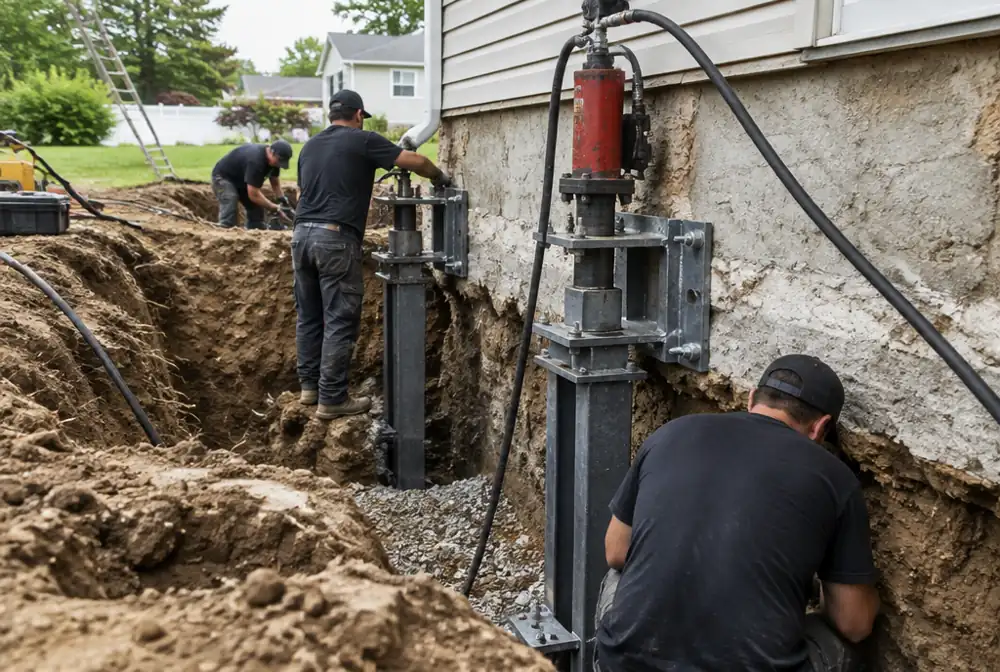
| Push piers | $1,500–$3,500 per pier | Steel tube sections hydraulically driven under the footing using the house's own weight, down to load-bearing strata | A heavy settling structure — the main house, a masonry wall — where you may also want to lift it back |
| Helical piers | $1,500–$3,000 per pier | Screw-type steel pier turned into the ground to a measured torque | Lighter loads: porches, stoops, additions, decks, new construction, and sites too light to drive a push pier |
| Slab piers | $1,200–$2,500 per pier | Small-diameter piers under an interior slab that has dropped away from the walls | Sunken interior slabs in a basement or garage where lifting the foam isn't enough |
| Carbon-fiber straps | $600–$1,100 per strap | High-strength fabric epoxied floor to ceiling, stops further inward movement | Block walls bowed under about 2 inches that are no longer actively moving |
| Steel wall anchors | $800–$1,600 per anchor | Wall plate inside, earth anchor in the yard, rod between them; can be tightened over time | Walls bowed more than about 2 inches, or still moving, where there's yard to excavate |
How the job goes
EvaluationThe foreman measures the wall with a string line or laser, maps the cracks, checks the floors with a level, and looks outside at the grade, the gutters and the downspouts. You get the honest verdict, including 'this isn't structural' when that's the answer.
EngineerStructural work gets a New Jersey licensed engineer's design: pier count, spacing, depth and load, or the anchor layout. You get the stamped plan. It's yours to keep and it's what a buyer's attorney asks for later.
PermitTownship building permit under the NJ Uniform Construction Code, filed with the engineer's plan attached. We meet the inspector.
ExcavationPits dug at each pier location down to the footing, or anchor holes opened in the yard. Landscaping and pavers lifted and set aside to go back.
InstallationPiers driven and load-tested one by one to the engineer's criteria, or wall plates and anchors set and tensioned. Every pier gets a recorded depth and pressure.
Lift or stabilizeWhere lifting is safe, we lift in small increments and watch the house. Where it isn't, we stabilize where it stands and we tell you why — before we start, not after.
Restore and sign offBackfill compacted, concrete and landscaping put back, interior cracks patched. Item-by-item walkthrough before you release final payment.
What piers can and can't do
Piers stop the settlement. That part is straightforward, and a properly designed and load-tested pier job stops it for good.
Getting the house back to level is a different question. Sometimes we can recover most of the drop; sometimes the finishes, the framing and the plumbing have settled into their new positions and lifting hard would crack more than it fixes. Anyone who promises a full lift before they've excavated and load-tested a single pier is guessing.
We tell you, in writing, whether the plan is 'stabilize' or 'stabilize and attempt to recover elevation,' and what that means for your drywall, your tile and your doors. Then you decide.
The engineer's letter and the warranty
When you sell, buyers and their attorneys will ask two things about a repaired foundation: who engineered it, and is the warranty transferable. Our structural work is done to a stamped New Jersey engineer's plan and comes with a written transferable warranty, so the answer to both is a piece of paper you can hand over.
We also fix the cause. Nearly every bowing wall we see has a gutter and grading problem feeding it, and a pier job with the downspouts still dumping at the footing is half a repair. Drainage, extensions, regrading and a perimeter drain go on the same quote, with prices, so you can see exactly what you're buying.
Foundation repair near you
Paramus-based, working on foundations across all 21 New Jersey counties. Text us a photo of the crack with a tape measure or a quarter next to it, plus a shot of the outside grade at the same spot, and we'll tell you whether it's worth a visit. Photos and any old engineer's report can go to info@firstcallcontractingnj.com; urgent movement, call (201) 676-3099.
PRICE CHECK · NEW JERSEY 2026$1.8K – $38Ktypical fixed-price range — your exact number goes in writing after a free visit
How we beat the big chains: The national foundation brands send a commissioned inspector with a tablet and a same-day discount that expires when he leaves your driveway. We send the foreman who'll run the job, and the price is good for 90 days because it doesn't need a gimmick. No franchise fees, no commissioned salesmen, no rented subcontractors — that's typically 15–30% under national-brand quotes for the same or better spec. Bring us any written quote and we'll match the scope line by line.
What people hate about other companies — fixed here
The complaint“The inspector quoted twenty-two thousand dollars and told me the price was only good if I signed before he left.”
Our fixOur written price is good for 90 days and there's no deposit. The person who quotes your job is the foreman who runs it, not a commissioned salesman with a countdown clock.
The complaint“They put in piers and never touched the downspouts dumping right at the corner that sank.”
Our fixWe look at the water first — gutters, downspouts, grade and the perimeter drain — and it goes on the same itemized quote as the piers. Fixing the structure without fixing the cause is half a job.
The complaint“There was no engineer involved, no permit, and now the buyer's attorney wants paperwork I don't have.”
Our fixEvery structural repair we do is built to a stamped New Jersey licensed engineer's plan and permitted through your township. You get the plan, the closed-out permit and a warranty that transfers to the next owner.
Foundation Piers & Wall Anchors questions, answered
How much does foundation repair cost in New Jersey in 2026?
Piers run about $1,500 to $3,500 each installed and most settlement jobs need six to twelve, so $12,000 to $38,000 is typical for underpinning. Bowing-wall work is much less: carbon-fiber straps are about $600 to $1,100 each and steel wall anchors about $800 to $1,600 each. Crack injection on a non-structural crack starts at our $495 minimum visit.
Which cracks are serious and which aren't?
Thin vertical shrinkage cracks in poured concrete are usually cosmetic and just need sealing. Stair-step cracks in block, diagonal cracks from window corners, and any horizontal crack across the middle of a wall are structural signals. The single most useful thing you can do is mark the end of the crack with a pencil and today's date — if it moves in six months, it's active.
Push piers or helical piers — which do I need?
Push piers use the weight of the structure to drive steel to load-bearing strata, so they suit heavy settling structures and give you the best shot at recovering elevation. Helical piers screw in to a measured torque and suit lighter loads — porches, stoops, additions, decks — and sites where there isn't enough weight above to drive a push pier. The engineer's plan decides, not a sales preference.
Can you lift my house back to level?
Sometimes, partly. Lifting is attempted after the piers are in and load-tested, in small increments, watching the structure. How much comes back depends on how long it's been down and how brittle the finishes are. We put in writing whether the plan is stabilization or stabilization with an attempted lift, and nobody should promise you a full lift before excavating.
Does homeowners insurance cover foundation repair?
Usually not for settlement, soil movement or hydrostatic pressure — most policies exclude earth movement. Sudden damage from a specific covered event can be different. Call your carrier with the specifics before you assume either way, and if there's a claim we'll document the damage with photos and an itemized scope for the adjuster.
Do I need a permit and an engineer for foundation work in NJ?
For structural work, yes to both. Your township issues a building permit under the NJ Uniform Construction Code and generally wants a stamped design from a New Jersey licensed engineer. We arrange the engineer, file the permit, meet the inspector and hand you the closed-out paperwork — which is what a buyer's attorney will ask for later.
Is there foundation piers & wall anchors near me?
If you're anywhere in New Jersey, yes. First Call Contracting is based in Paramus and handles foundation piers & wall anchors across all 21 counties with our own licensed crew. Most of Bergen, Passaic, Hudson and Essex is 15 to 30 minutes from our shop, and emergencies are dispatched to the nearest crew 24/7. Call (201) 676-3099 or book a free in-home estimate.
Stopped. On paper.
Engineer's plan · township permit · transferable warranty
Or call Alex direct: (201) 676-3099